The 12 Earthly Branches: Animal Signs & Hidden Elements
Learn what the 12 Earthly Branches really mean in Korean Saju, animal signs, hidden stems, seasonal energy, and how they shape your destiny.
The 12 Earthly Branches Explained: Animal Signs, Hidden Elements, and What They Mean in Your Saju Chart
If you've ever gotten a Saju reading and wondered why your animal sign barely got mentioned, you're not alone. Most people come in expecting to talk about their Chinese zodiac sign, and I have to gently redirect them: in Korean Saju (Four Pillars of Destiny), the Earthly Branches are doing something far more complex than just labeling you a Tiger or a Rabbit.
The 12 Earthly Branches (지지, Jiji) are one half of every single pillar in your chart. Each of your four pillars, Year, Month, Day, and Hour, has a Heavenly Stem on top and an Earthly Branch on the bottom. You're working with eight characters total, and the branches hold some of the most layered information in the entire system. Want to see how this plays out in your own chart? Try the free reading to get your four pillars laid out.
Here's the thing most beginners miss: each Earthly Branch isn't just an animal. It carries elemental energy, a season, a time of day, and most critically, hidden stems buried inside it. Those hidden stems are called 지장간 (Jijanggan), or "hidden heavenly stems," and they can completely change the character of your chart.
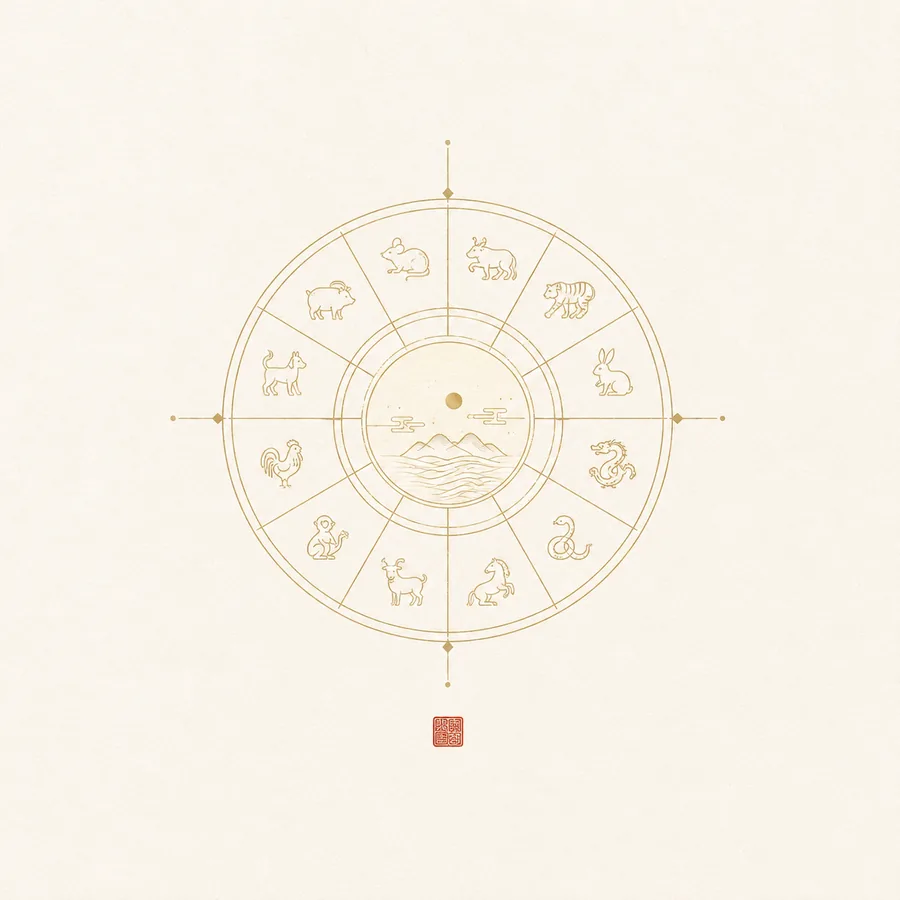
The 12 Earthly Branches at a Glance
Let me walk through all twelve, but I'm going to give you the information that actually matters for Saju readings, not just the folklore.
The branches run in a cycle that maps perfectly onto the seasonal calendar. This is important. In Saju, time is elemental, and the branches are literally a time map.
子 Ja (Rat): Pure Water energy. Peak winter, midnight energy (11pm-1am). The most concentrated Yin Water in the entire system. Deeply intuitive, hidden, quiet on the surface.
丑 Chuk (Ox): Earth with hidden Water and Metal. Late winter, transitional. This is one of the "cemetery" or storage branches, which I'll explain more below.
寅 In (Tiger): Yang Wood energy with hints of Fire and Earth hidden inside. Early spring. One of the most active, initiating energies in the whole branch system.
卯 Myo (Rabbit): Pure Yin Wood. Full spring, sunrise. Gentler than Tiger but deeply rooted. The most concentrated Wood branch.
辰 Jin (Dragon): Earth with hidden Wood and Water. Late spring transition. Another storage branch, often the most complex one to read.
巳 Sa (Snake): Yang Fire with Metal and Earth hidden inside. Early summer. Deceptively intense, strategic.
午 O (Horse): Fire and Earth. Peak summer, noon energy. Radiating, expansive, the loudest Fire branch.
未 Mi (Goat): Earth with hidden Fire and Wood. Late summer transition. Warm, nurturing, another storage branch.
申 Sin (Monkey): Yang Metal with Water and Earth hiding inside. Early autumn. Sharp, decisive, fast-moving.
酉 Yu (Rooster): Pure Yin Metal. Peak autumn, sunset. The most refined, precise Metal energy. No hidden stems, what you see is what you get.
戌 Sul (Dog): Earth with hidden Metal and Fire. Late autumn transition. The fiercest storage branch, with a tension between Fire and Metal inside.
亥 Hae (Pig): Yang Water with Wood hidden inside. Early winter. The beginning of the water cycle, expansive and philosophical.
What Are Hidden Stems (지장간 Jijanggan) and Why Do They Matter?
Okay, this is where it gets genuinely interesting. And honestly, this is one of the most misunderstood mechanics in all of Saju.
Every Earthly Branch contains one to three Heavenly Stems compressed inside it. Think of the branch as a container, and the hidden stems as the actual contents. The animal sign is the label on the box. The Jijanggan is what's inside.
So when your Day Branch (the branch in your Day Pillar, directly under your Day Master) contains a hidden stem that matches or feeds your Day Master, that's significant. It means you have internal resources, a kind of built-in support system.
For example: if your Day Master is 甲 Gap (Yang Wood), and your Day Branch is 亥 Hae (Pig), which holds Yang Water hidden inside, your chart has Water feeding Wood from below. The Productive Cycle (상생) working quietly in your foundation. This person tends to have an inner depth that others don't see right away.
Contrast that with someone whose Day Branch is 申 Sin (Monkey), which carries Yang Metal hidden inside. Metal cuts Wood. That's tension right in the core of your identity pillar. Not automatically bad, but it creates a person who often struggles with self-doubt or internal conflict. I've seen this pattern in many clients who describe feeling like they're constantly fighting themselves.
The Four Storage Branches: 辰戌丑未
The branches 辰 (Dragon), 戌 (Dog), 丑 (Ox), and 未 (Goat) are called the Earth storage branches, or sometimes the "graveyard" branches (墓庫, Mogo). They appear at the transitional points of each season, and they share one thing in common: they're all Earth element on the surface, but they're storing energy from the season that just ended.
Dragon stores late spring Water and Wood. Dog stores late autumn Fire and Metal. Ox stores late winter Water and Metal. Goat stores late summer Fire and Wood.
Why does this matter in a reading? Because storage branches are powerful but complex. The energy inside them isn't freely available. It needs to be unlocked, either by a matching element in another pillar, or by a specific Annual Fortune (연운 Yeonun) year. Some of my most interesting client charts have been people with multiple storage branches who felt like late bloomers, like their best potential only started manifesting in their 30s or 40s.
The Three Harmonies and Six Combinations: When Branches Talk to Each Other
Branches don't just sit there independently. They interact. Two of the most important patterns are the Three Harmonies (삼합 Samhap) and the Six Combinations (육합 Yukhap).
Three Harmonies (삼합)
Certain sets of three branches combine to produce a single concentrated element:
- 寅 午 戌 (Tiger, Horse, Dog) → Fire
- 申 子 辰 (Monkey, Rat, Dragon) → Water
- 巳 酉 丑 (Snake, Rooster, Ox) → Metal
- 亥 卯 未 (Pig, Rabbit, Goat) → Wood
If you have two out of three of these in your chart, that's called a "partial harmony," and it still leans the elemental balance noticeably in that direction. Three out of three creates a strong elemental force that can dominate the chart.
Six Combinations (육합)
These are branch pairings that transform into a different element when they sit adjacent in a chart:
- Rat (水) + Ox (土) → Earth
- Tiger (木) + Pig (水) → Wood
- Rabbit (木) + Dog (土) → Fire
- Dragon (土) + Rooster (金) → Metal
- Snake (火) + Monkey (金) → Water
- Horse (火) + Goat (土) → Fire/Earth
These combinations can fundamentally change what a branch is contributing to your chart. A Rooster branch that looks like pure Metal might combine with Dragon and shift into something else entirely. This is exactly why Saju isn't something you can read from a birth year alone.
Where Your Branch Sits Changes Everything
The same branch means something different depending on which pillar it's in.
The Year Branch shows your generational energy, family roots, and social environment. The Month Branch is arguably the most powerful for everyday life, it governs your career and the elemental season you were born into. The Day Branch is your closest partner, representing your inner world and often describing your actual romantic relationship. The Hour Branch points toward children, late-life fortune, and your hidden desires.
If you're curious about how your Day Branch interacts with a partner's chart, that's exactly the kind of layered analysis that goes into a Saju love reading.
Frequently Asked Questions
What is an Earthly Branch in Saju?
An Earthly Branch (지지 Jiji) is the bottom character in each of the Four Pillars. There are 12 branches, each corresponding to an animal sign, an element, a season, and a time of day. They also contain hidden heavenly stems (Jijanggan) that reveal deeper layers of elemental energy in your chart.
Is my animal sign the same as my Earthly Branch?
Your birth year animal sign corresponds to your Year Branch, but your chart has four branches total (Year, Month, Day, Hour). The animal sign is essentially a nickname for the branch. In Saju, the elemental and hidden stem qualities of a branch matter far more than the animal label itself.
What are hidden stems (지장간) and how do they affect my reading?
Hidden stems are one to three Heavenly Stems compressed inside each Earthly Branch. They reveal what elemental energy is stored within a pillar and can show internal resources, tensions, or karmic themes depending on how they interact with your Day Master (일간 Ilgan).
Which Earthly Branch is the most powerful?
This really depends on your chart. However, the Month Branch is considered the most influential for general life direction because it governs your career sector and reflects the seasonal energy you were born into. The Day Branch is the most personally intimate, directly describing your inner self and relationships.
Understanding the Earthly Branches properly takes time. But once you see how the hidden stems, seasonal energy, and branch interactions layer together, you start reading charts in a completely different way. It stops being about "oh you're a Dragon" and starts being about something genuinely specific to you.
Discover Your Destiny
Curious about your own chart?
Get a free mini reading, then unlock your full Four Pillars report from a certified Saju master.